Hamza
April 30, 2026
0 Comment
If you want SEO to increase eCommerce sales in 2026 in the UAE, you need more than traffic. You need product pages, category pages, content, schema, feeds, and checkout paths that help shoppers find the right product and buy with confidence.
That means your SEO strategy should answer one question at every step:
Does this page help the shopper move closer to a purchase?
If the answer is no, the page needs work. Let’s look at how you can fix it.
Key Takeaways
Buyer keywords drive sales when they match what shoppers want to do next. Some people are researching, some are comparing, and some are ready to buy. Your SEO should separate those stages clearly, so your product and category pages target searches that can lead to revenue.
Buyer-intent keywords are search terms that show purchase interest. They often include words like buy, price, best, review, discount, delivery, online, near me, and available now.
This is where many online stores get lazy. They chase big search volume and ignore whether the visitor is ready to act.
For example, “wireless earbuds” is broad. It may bring traffic, but the intent is unclear. A stronger search would be “buy noise-cancelling earbuds online” or “best wireless earbuds for calls.” These searches tell you what the buyer wants and what page should serve them.
A Dubai electronics store, for example, could target searches like:
That is how keyword research becomes sales-focused instead of vanity-focused.
A money keyword usually shows that the shopper wants to buy, compare, check price, confirm delivery, or reduce risk before ordering.
Search Intent | Example Query | Best Page Type |
Buy | buy leather wallet online | Product or category page |
Compare | leather vs vegan wallet | Comparison guide |
Price | men’s wallet price | Category page |
Delivery | same-day gift delivery | Category or landing page |
Trust | is this product original | Product FAQ |
Even branded searches should have a clear page if people are searching for them. A branded page should explain what the product, brand, or store is, what it offers, and why shoppers can trust the information.
Your store does not need random traffic. It needs a clear SEO system built around buyer intent, product visibility, page quality, and revenue. Contact us to discuss how our approach connects strategy, content, technical SEO, and conversion-focused improvements.
Category pages capture buyer demand by matching broad shopping searches where users want options. A product page sells one item, but a category page helps shoppers compare several choices. This makes category pages valuable for commercial searches like “men’s sneakers,” “office chairs,” or “organic skincare.”
A category page should not be just a product grid. That is weak. It should guide the buyer without slowing them down.
A good category page includes:
For example, a skincare store selling moisturisers can create a category page for “moisturisers for oily skin.” The page can show products, explain lightweight textures, mention common ingredients, and answer basic questions about daily use.
That helps the shopper choose faster.
Strong category pages need a clean structure, useful filters, short supporting copy, and internal links to related pages.
The goal is not to write a long essay above the products. The goal is to help shoppers narrow their choices.
A useful layout can look like this:
Keep the top of the page shopping-first. Put longer supporting content below the products so users do not have to scroll forever before seeing what you sell.
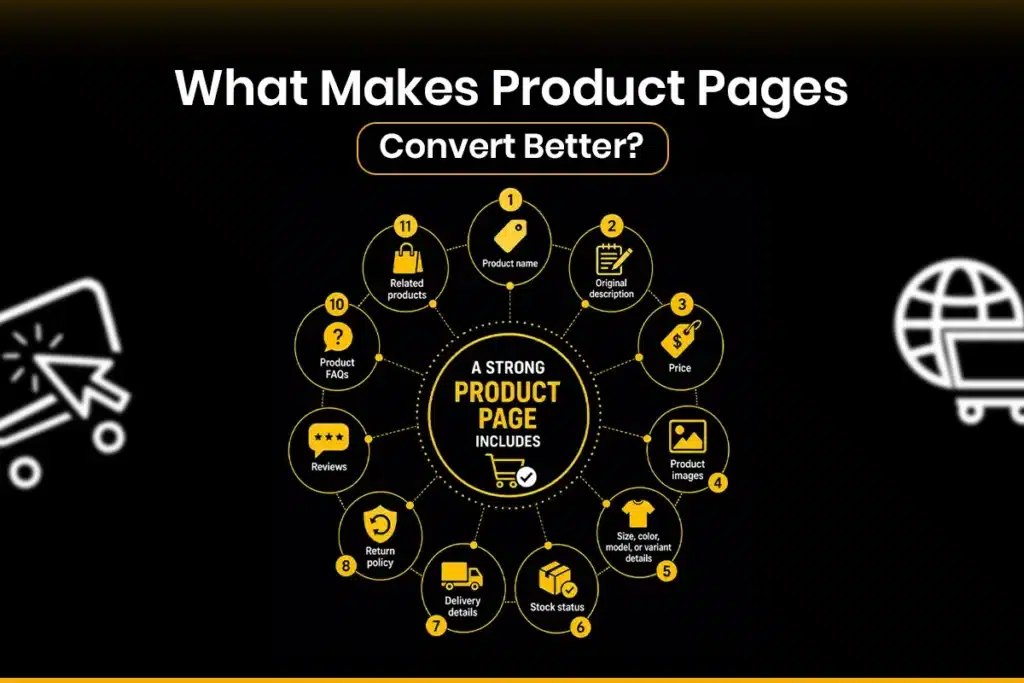
Product pages convert better when they remove buyer doubt. A shopper should quickly understand what the product is, who it is for, what it costs, whether it is available, and what to expect after purchase. If the page creates confusion, the sale becomes harder.
A product page is your final sales conversation before checkout. It should answer the questions a real shopper would ask.
A strong product page includes:
Do not write vague product copy like “premium quality product for daily use.” That tells the buyer nothing.
Better copy sounds like this:
“This lightweight office chair is designed for daily desk work. It has adjustable height, padded armrests, and a breathable mesh back. It is best for home offices, study rooms, and compact workspaces.”
That is clearer. It gives the buyer something useful.
Product details build trust when they answer practical questions before the buyer has to ask.
Use details like:
For example, if you sell shoes, mention whether they run true to size. If you sell skincare, mention skin type. If you sell electronics, mention warranty and compatibility.
This is not extra content. This is sales support.
Product images help both search visibility and conversions when they are clear, fast, and descriptive. Search engines rely on image signals like filenames, alt text, and page context to understand what the image represents.
To optimize product images:
Alt text example:
“Black leather wallet with multiple card slots and slim design”
Bad example:
“image123.jpg”
Image optimization helps your product appear in Google Images, product listings, and visual search, while also improving page speed and user experience.
If your product pages rank but do not convert, or your category pages are not bringing qualified shoppers, an expert audit can show what is holding sales back. We review intent, schema, product feeds, UX, content gaps, and revenue metrics.
Product schema improves visibility because it helps search engines understand your product information in a structured format. It does not replace useful page content, but it can make details like price, stock, reviews, shipping, and product images easier for Google to process.
According to Google Search Central, product structured data can help product information appear in richer ways across Google Search, including details such as price, availability, review ratings, and shipping information. (Google for Developers)
Use schema for clarity, not tricks. The information in your schema must match what users see on the page.
Important schema types include:
If a product is out of stock, your schema should not say it is available. If the product has no real reviews, do not add fake ratings. That is not strategy. That is asking for trouble.
The most useful schema details are the ones that describe the product clearly.
Focus on:
For example, a fashion store should mark up color, size, price, stock, and images. A furniture store should mark up product name, material, dimensions, price, and availability.
Schema works best when your page content is already strong.
Product feeds support shopping SEO by giving Google clean product data through Merchant Center. A feed helps Google understand what you sell, how products are priced, whether they are available, and which shopping searches they match. Bad feed data can reduce visibility before users even reach your site.
This section is about feeds, not schema. Keep those separate.
Common feed problems include:
A weak product title would be:
“Running Shoes”
A stronger title would be:
“Women’s White Running Shoes Size 40 Lightweight Sole”
The second title gives both the shopper and Google more context.
If you offer Ecommerce SEO Services Dubai, apply the same logic to your own service pages. Clear naming, clear value, and accurate page information matter just as much for services as they do for products.
Feed errors reduce sales when they stop your products from matching relevant shopping searches or create confusion after the click.
The biggest issues are inaccurate prices, missing product identifiers, poor product titles, and stock mismatches.
A clean product feed should answer:
Product feed quality is not just a technical job. It affects discovery, clicks, and sales.
Comparison content helps mid-funnel buyers who are still deciding between products, materials, brands, or features. These shoppers may not be ready to buy yet, but they are close enough to become valuable visitors if your content gives them a clear and honest answer.
This section should not repeat product page advice. Product pages help buyers confirm one item. Comparison content helps them choose between options.
People search for things like:
These queries show research with commercial value.
A good comparison page should not sit on the fence forever. It should explain the difference and guide the buyer.
For example:
“Choose linen bedsheets if you want a breathable, relaxed feel. Choose cotton bedsheets if you want a smoother texture and easier care.”
That is useful. It helps people move forward.
Comparison pages should start with a quick answer, then explain the differences in a simple structure.
Use:
Do not make users scroll through 1,500 words before they get the answer. Give them the answer first, then explain it.
This format works well for readers, featured snippets, People Also Ask results, and answer-style search experiences.
Long-tail answers win AI search because they answer specific buyer questions in clear language. Shoppers often search detailed questions before buying, and your website should answer them directly on product, category, comparison, and FAQ pages without burying the answer.
AEO means Answer Engine Optimization. It helps your pages answer buyer questions clearly for search engines and answer-based results.
GEO means Generative Engine Optimization. It makes your content easier for generative search tools to understand, summarize, and reference.
Define these terms once. Do not force them into every section.
Good long-tail questions include:
These questions remove hesitation.
You should answer questions that affect product choice, price confidence, delivery expectations, returns, warranty, size, compatibility, and use case.
For example, a shoe page can answer:
A beauty product page can answer:
A strong local seo agency maps these questions to the right page type instead of dumping all FAQs into one generic blog.
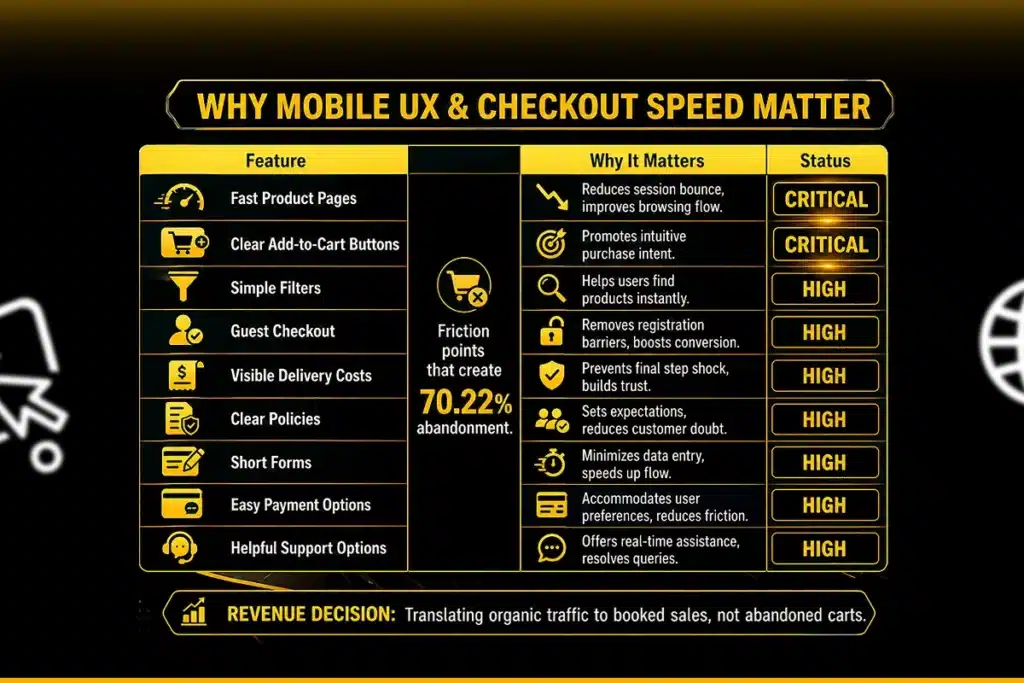
Mobile UX and checkout speed matter because shoppers leave when buying feels slow, confusing, or risky. SEO can bring users to your store, but checkout experience decides whether that visit becomes revenue. A smooth buying path protects the value of your organic traffic.
According to Baymard Institute, the average documented cart abandonment rate is 70.22%, based on 50 studies, and large eCommerce sites can improve conversion rates by up to 35% through better checkout design. (Baymard Institute).
That should make you uncomfortable in a useful way.
You can rank well, attract the right users, and still lose sales because your checkout creates friction.
Focus on:
Do not hide important costs until the final step. That feels sneaky, and shoppers hate it.
You reduce checkout friction by removing anything that slows the buyer down or creates doubt.
Start with these fixes:
Real example:
A home decor store noticed that many mobile users added lamps to cart but left at the shipping stage. The problem was not the product. The delivery charge appeared too late. Once the store showed delivery cost earlier, checkout felt clearer and fewer shoppers dropped off.
That is practical SEO. Not glamorous, but profitable.
SEO proves real revenue growth when it shows how search visitors move from landing on your site to viewing products, adding items to cart, and completing purchases. Rankings and impressions are useful signals, but they do not show business impact. What matters is how SEO contributes to actual sales.
Focus on metrics that connect search performance to buying behavior:
Instead of tracking numbers in isolation, ask practical questions:
This is where SEO shifts from reporting activity to driving results.
The most important eCommerce SEO metrics are organic revenue, conversion rate, add-to-cart rate, checkout completion, and assisted conversions. These show how effectively your traffic turns into customers.
A monthly review should connect search data to user behavior:
Metric | What It Shows |
Organic revenue | Direct impact of SEO on sales |
Add-to-cart rate | How well product pages engage buyers |
Checkout completion | How smooth the purchase process is |
Category clicks | How easily users discover products |
Assisted conversions | SEO’s role in the buying journey |
If your SEO reports focus only on rankings, impressions, or traffic, they are missing the bigger picture.
The best eCommerce SEO strategy in 2026 is focused, practical, and revenue-led.
Your buyer keywords should match real purchase intent. Your category pages should capture broad demand. Your product pages should remove doubt. Your schema should clarify facts. Your feeds should stay accurate. Your comparison content should guide research. Your long-tail answers should support discovery. Your checkout should reduce friction. Your metrics should prove sales impact.
When all of these parts work together, SEO stops being a visibility tactic and becomes a growth system.
At alrwyt alwash, this is exactly how we approach eCommerce SEO. Not as a checklist, but as a structured system designed to help online stores attract the right visitors, guide them clearly, and turn that attention into consistent sales.
Turn your online store into a stronger organic sales channel with SEO built for product visibility, useful content, technical performance, and smoother buyer journeys.
eCommerce SEO is the process of improving product pages, category pages, technical setup, content, and structured data so online stores can attract shoppers from search engines and turn them into buyers.
Google Merchant Center is a platform that lets online stores submit product data to Google for Shopping results, free listings, and product visibility across Google surfaces.
AEO means Answer Engine Optimization. It helps product, category, and FAQ content answer buyer questions clearly for search engines and provides answer-based results.
GEO means Generative Engine Optimization. It makes content easier for generative search tools to understand, summarize, and reference when users ask shopping-related questions.
Checkout experience matters because shoppers leave when forms are long, costs are hidden, payment options are unclear, or pages load slowly.
Yes, blogging helps when it targets product-related queries like comparisons, buying guides, and product use cases. It brings early-stage traffic and supports category and product pages through internal linking.
Do not delete out-of-stock product pages. Keep the page live, show “out of stock” clearly, suggest similar products, and keep the URL active so rankings and links are not lost.
Mobile-first indexing matters because search engines use the mobile version of your site for ranking. If your product pages are slow, hard to use, or incomplete on mobile, both rankings and conversions can drop.


