Hamza
April 21, 2026
0 Comment
Dubai’s healthcare sector is rapidly evolving, and digital visibility has become essential for patient acquisition. A well-structured healthcare SEO strategy ensures clinics and hospitals can reach patients at the exact moment they are searching for medical information or services. However, unlike general SEO, healthcare marketing must balance performance with strict regulatory compliance and high standards of accuracy.
|
This guide outlines how to build a results-driven, DHA-compliant digital marketing strategy that prioritises trust, expertise, and patient safety. From keyword research to EEAT and technical SEO, each element is designed to help healthcare providers rank effectively while maintaining credibility in a highly competitive and regulated environment.
Key Takeaways
Dubai’s healthcare sector is one of the fastest-growing in the world, with the Dubai Health Authority (DHA) licensing thousands of clinics, hospitals, and specialist centres across the emirate. In this highly competitive landscape, digital visibility is no longer optional — it is a core patient acquisition channel. Yet healthcare SEO in Dubai carries obligations that go beyond standard digital marketing: Google’s toughest content standards apply, and DHA regulations govern how licensed providers may communicate with the public online.
Google’s medical ranking standards change fast. Secure our 47-point Healthcare SEO Checklist to identify your site’s hidden gaps and align your strategy with current E-E-A-T requirements.
Pages that discuss medical conditions, treatments, medications, mental health, or healthcare providers fall into Google’s Your Money or Your Life (YMYL) category. These are pages where inaccurate or unhelpful content could have serious real-world consequences for a reader’s health, safety, financial stability, or welfare. For Dubai-based healthcare organizations, this algorithmic reality is compounded by the DHA’s own digital content guidelines, which require accuracy, transparency, and prohibition of misleading health claims.
YMYL + DHA — Dual Compliance: Healthcare providers in Dubai must satisfy two overlapping frameworks: Google’s YMYL quality standards (which determine search visibility) and the Dubai Health Authority’s advertising and digital content regulations (which govern legal compliance). A Healthcare SEO Agency in Dubai, like Alrwyt Alwash, is experienced in navigating both — building strategies that rank highly while remaining fully DHA-compliant.
77% UAE patients research symptoms online before seeing a doctor 5% of all Google searches globally are health-related queries 3x Higher trust in medically reviewed vs unreviewed content 62% Of Dubai patients choose providers found via organic search |
|
Not all healthcare content carries equal YMYL weight. A blog post about general wellness habits carries less risk than a page describing medication dosages or surgical procedures. In Dubai’s multilingual market — where content may need to serve Arabic, English, Hindi, and Urdu-speaking patient populations — the complexity increases further.
Understanding where your content falls on the YMYL spectrum helps you calibrate the level of clinical oversight required. Condition-specific treatment pages, drug interaction information, and mental health crisis resources represent the highest YMYL tier and demand the most rigorous review processes.
Rankings are vanity; patient volume is reality. Join our 2026 GCC Strategy Webinar to see the exact frameworks Dubai clinics are using to triple their organic appointment bookings.
A healthcare SEO strategy without measurable goals is both inefficient and potentially risky. Define clear objectives tied to patient acquisition, brand authority, clinical accuracy maintenance, and compliance before any content or technical work begins. Your KPIs should reflect the full patient journey, not just traffic metrics.
Healthcare keyword research in Dubai sits at a unique intersection: clinical terminology, patient lay language, Arabic and English search behaviour, and hyper-local intent. Patients in Dubai search in English, Arabic, and often in transliterated Arabic, presenting an opportunity that many healthcare providers underutilise. An experienced Healthcare SEO firm understands how to target all three search contexts simultaneously.
Start with intent-first keyword mapping. In healthcare, intent has moral dimensions. A search for “chest pain left arm Dubai” may indicate someone in a medical emergency — creating an ethical obligation to surface emergency information alongside SEO-optimized content. Your SEO Agency Dubai partner should help you map keyword intent not just to conversion funnels but also to patient safety considerations.
|
Keyword categories for healthcare SEO:
Google’s understanding of medical topics has become sophisticated enough to evaluate topical authority — not just individual keyword optimization. Rather than creating isolated pages for each keyword, build content clusters: a comprehensive pillar page covering a broad medical topic (e.g., “Diabetes Treatment in Dubai”) supported by tightly interlinked cluster pages addressing subtopics (symptoms, DHA-approved treatments, specialist directories, diet guidance, complications). For Arabic-speaking patients, consider parallel Arabic-language cluster pages targeting the same topic in Arabic search queries.
Alrwyt Alwash’s content cluster methodology is purpose-built for the UAE healthcare market — mapping English and Arabic keyword clusters to DHA-regulated service categories and Dubai’s distinct patient demographics, including expat communities from South Asia, Europe, and the Arab world.
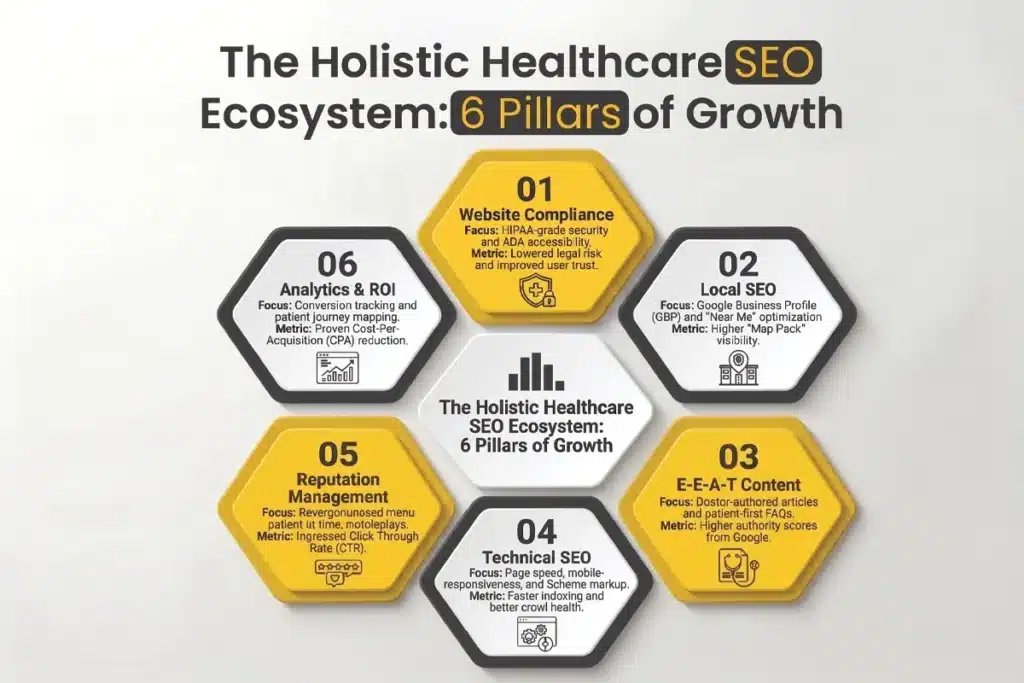
Google’s EEAT framework (Experience, Expertise, Authoritativeness, Trustworthiness) is the central quality evaluation lens for all YMYL content. In healthcare, EEAT isn’t a style guide — it’s a survival requirement. Content that fails EEAT evaluation by Google’s quality raters will struggle to rank regardless of technical optimization.
“Healthcare organizations that invest in clinician-authored or clinician-reviewed content consistently outperform those relying on content marketers alone. The trust signal from a named, credentialed medical author is among the strongest single ranking factors for YMYL healthcare pages in 2025.”
Google now rewards content that demonstrates lived or professional experience with a topic. For healthcare, this means content written or co-written by clinicians who treat the conditions discussed, or by patients sharing medically verified personal accounts. Avoid purely derivative content that aggregates existing information without adding clinical insight.
Every clinical article should have an author or reviewer with verifiable credentials: medical degree, board certification, speciality training, and institutional affiliation. Author bio pages must be comprehensive, link to LinkedIn or professional profiles, and ideally reference peer-reviewed publications or speaking engagements.
Authoritativeness is largely determined by external signals: backlinks from medical journals, citations by other credible healthcare organisations, mentions in medical news outlets, and the professional reputation of your authors. Building authoritativeness takes time, but it is one of the most durable competitive advantages in healthcare SEO.
Trust is built through: clear sourcing of clinical claims to primary research, visible “last reviewed” dates, honest acknowledgement of medical uncertainty, accessible contact information, patient privacy policies, and a medical disclaimer. Trustworthiness is the umbrella under which the other EEAT components operate.
Each author should have a dedicated bio page that is internally linked from every article they write or review. The bio page should include: full name and professional photo, all degrees and certifications with years obtained, current institutional affiliation, speciality and clinical focus areas, a list of co-authored peer-reviewed publications, links to LinkedIn and professional association profiles, and a brief personal statement connecting their clinical experience to their writing.
Not all content formats perform equally in healthcare SEO. The most effective formats combine high clinical value with strong search intent alignment and clear EEAT signals. Understanding which formats to prioritise — and when — is essential for efficient content production.
Content Type | Primary Intent | EEAT Requirement | SEO Value | Production Cost |
Condition/Disease guides | Informational | MD review required | High | Medium |
Treatment comparison pages | Consideration | Specialist review | High | Medium |
Physician profile pages | Decision | Verified credentials | High | Low |
FAQ/symptom checkers | Informational | Clinical accuracy check | Medium | Low |
Patient success stories | Decision | HIPAA consent required | Medium | Medium |
Research / clinical news | Informational | Primary source citation | Medium | Medium |
Build one comprehensive pillar page (2,500–4,000 words) covering a broad medical topic, then create 6–10 supporting cluster pages (800–1,500 words) on related subtopics. Interlink all cluster pages to the pillar and to each other. This architecture signals topical authority to Google while creating a useful patient education ecosystem.
Technical SEO provides the foundation on which all content and EEAT efforts rest. A healthcare website with excellent clinical content but poor technical fundamentals will underperform. Conversely, a technically pristine site with thin or unreliable medical content will also fail to rank. Both layers must be strong simultaneously.
Google’s Core Web Vitals (Largest Contentful Paint, Interaction to Next Paint, Cumulative Layout Shift) are ranking signals for all websites, but in healthcare, they carry an additional dimension: patient experience. A slow-loading page when a user is searching anxiously for health information contributes to real user distress. Targeting LCP under 2.5 seconds, CLS below 0.1, and INP under 200ms should be the minimum technical standards for any healthcare property.
// MedicalWebPage + Physician Schema { “@context”: “https://schema.org”, “@type”: “MedicalWebPage”, “name”: “Type 2 Diabetes: Symptoms, Causes & Treatment”, “about”: { “@type”: “MedicalCondition”, “name”: “Type 2 Diabetes Mellitus”, “code”: { “@type”: “MedicalCode”, “codeValue”: “E11”, “codingSystem”: “ICD-10” } }, “author”: { “@type”: “Physician”, “name”: “Dr. James Okonkwo, MD”, “medicalSpecialty”: “Endocrinology” }, “reviewedBy”: { “@type”: “Physician”, “name”: “Dr. James Okonkwo, MD” }, “dateReviewed”: “2025-04-01”, “medicalAudience”: “Patient”, “lastReviewed”: “2025-04-01” } |
Your Google Business Profile (GBP) is the single most important local SEO asset for any Dubai medical practice. A fully optimized GBP generates consistent appointment bookings from “near me” searches, independent of the broader organic strategy.
Key optimisations specific to Dubai include: setting your service area to the correct Dubai district (Downtown, JLT, Business Bay, etc.), listing in both English and Arabic where possible, specifying which UAE insurance networks you accept (Daman, AXA, Oman Insurance), adding photos of your clinic reception and DHA licence display, enabling WhatsApp appointment booking links in the profile, and maintaining an active review acquisition strategy in both Arabic and English.
For most medical practices in Dubai — primary care polyclinics, speciality clinics, dental centres, dermatology practices, physiotherapy studios — local SEO represents the single highest-return digital marketing investment. When a patient searches “cardiologist in Dubai Marina” or “DHA-licensed dermatologist JBR,” they are at the bottom of the decision funnel. Capturing this traffic converts to appointments at dramatically higher rates than informational health content. As the leading Healthcare SEO Agency in Dubai, Alrwyt Alwash specialises in high-intent, hyper-local patient acquisition.
Dubai Review Strategy
Post-appointment review requests via WhatsApp (the dominant communication channel in the UAE) generate significantly higher response rates than email. Send a personalized Arabic or English message — matching the patient’s language preference — within 24–48 hours of the appointment. Respond professionally to all reviews, including Arabic-language feedback. Prospective Dubai patients read responses as carefully as they read the reviews themselves.
Name, Address, and Phone (NAP) consistency across UAE-specific online directories — Google, DHA provider directory, Zocdoc UAE, Clinics. ae, HealthHub.ae, and insurance network portals — are foundational to local SEO authority in Dubai. Inconsistencies between your DHA licence address and your Google Business Profile address are a particularly common issue that Alrwyt Alwash audits in every client engagement. A single NAP inconsistency can significantly dilute the local ranking signals that determine your position in Dubai’s “local pack” search results.
The Dubai Health Authority (DHA) regulates all health-related advertising, digital content, and marketing communications by DHA-licensed healthcare providers in Dubai. Unlike many markets where digital marketing compliance is self-regulated, the DHA maintains active oversight of healthcare advertising — including online content, social media campaigns, and search marketing — with the authority to issue warnings, fines, and licence suspensions for violations. Any credible Healthcare SEO Agency in Dubai must understand and work within these regulations.
DHA’s healthcare advertising guidelines prohibit: misleading or exaggerated health claims, before-and-after patient imagery without regulatory approval, promotion of specific drug brands directly to patients, guarantees of treatment outcomes, and testimonials that could be construed as medical endorsements. Digital content must also comply with UAE Federal Law No. 2 of 2019 on the Use of Information and Communication Technology (ICT) in Health Fields, which governs patient data handling in digital environments.
Healthcare organizations in Dubai can continue using web analytics and digital advertising with careful configuration aligned to UAE data protection requirements. Key steps include: anonymising all patient-identifiable IP addresses in analytics platforms, disabling data-sharing settings that transmit patient interaction data to third-party modelling systems, excluding appointment booking pages, symptom checkers, and patient portal pages from tracking pixel scope, implementing server-side tag management to maintain control over data transmitted to advertising platforms, and maintaining a publicly accessible UAE PDPL-compliant privacy policy on every page of your website.
In healthcare SEO, link quality matters infinitely more than link quantity. A single backlink from a peer-reviewed medical journal, a federal health agency, or a top-50 academic medical centre is worth more than hundreds of links from general health blogs or directories. Healthcare link building requires a patient, relationship-driven approach that aligns with the professional standards of the medical community.
Publish original research, case studies, or literature reviews in peer-reviewed medical journals. Even letters to the editor or commentary pieces in journals like JAMA, NEJM, or UAE-based publications like the Journal of the Emirates Medical Association generate extremely high-authority backlinks that signal credibility to Google’s YMYL algorithms.
Register your physicians with journalist databases like HARO (Help a Reporter Out) and Qwoted. Journalists regularly seek medical experts for health articles in major publications. A single expert quote in a top national outlet can generate a link with significant authority.
Active involvement in state and national medical associations — presenting at conferences, contributing to association publications, serving on committees — generates organic, high-authority links from .org domains with strong healthcare topical relevance.
Ensure your physicians are listed in hospital medical staff directories, affiliated health system “find a doctor” tools, and insurance network provider directories. These are often authoritative .org or .edu adjacent domains with strong local and topical signals.
Healthcare SEO reporting must connect organic search activity to real business outcomes — patient appointments, consultation requests, and revenue — not vanity metrics like impressions or raw traffic volume. Building this reporting infrastructure requires careful integration between your SEO tools, analytics platform, and practice management system.
Use Google Search Console to monitor keyword ranking trends, identify YMYL pages with declining impressions (often an early signal of a future core update impact), and track click-through rates by query type. Connect GA4 (properly configured for HIPAA) to track goal completions — form submissions, click-to-calls, and appointment booking events — as the ultimate measure of SEO ROI.
Establish a monthly reporting cadence that includes: total organic sessions, new patient inquiries from organic, top-ranking clinical keywords and position changes, content freshness audit results (pages overdue for clinical review), and Core Web Vitals health across clinical page templates. Quarterly reports should include domain authority trends, backlink quality changes, and competitive share-of-voice in key condition categories.
A durable healthcare digital marketing strategy is not built on algorithmic tricks or content shortcuts — it is built on the same foundation that earns patient trust in clinical settings: genuine expertise, honest communication, clinical accuracy, and a demonstrable commitment to patient wellbeing.
The healthcare organizations that will win organic search in the next five years are those that invest in physician-authored and reviewed content, build topical authority through deep clinical knowledge, maintain technical excellence as a baseline, and treat SEO as an extension of their clinical mission rather than a marketing side project.
YMYL is not a constraint to navigate around — it is an opportunity. Healthcare organizations with genuine clinical credibility have an inherent EEAT advantage over generic health information sites. The challenge is making that credibility legible to both Google’s algorithm and to the patients searching for the care you provide.
Start with a content audit, identify your strongest EEAT assets (your physicians, your clinical track record, your institutional reputation), and build your SEO strategy outward from that foundation. Results will follow.
Every day you aren’t in the Top 3, your competitors win. Get a custom roadmap to outperform local clinics and maximize your ROI on patient acquisition.
A digital marketing strategy for healthcare SEO is a structured plan that helps clinics and hospitals appear in search results when patients look for medical information or services. It combines keyword research, high-quality medical content, technical website optimization, and local SEO.
In Dubai, this strategy must also align with DHA regulations and Google’s YMYL standards. This means your approach should not only focus on ranking higher but also on delivering accurate, safe, and trustworthy medical information that supports patient decision-making.
E-E-A-T (Experience, Expertise, Authoritativeness, Trustworthiness) is critical because healthcare content directly impacts people’s health and safety. Google applies stricter standards to such content under YMYL guidelines.
For a medical website, this means content should be written or reviewed by qualified professionals, include clear author credentials, and be regularly updated. Strong E-E-A-T signals help your website rank better and build patient trust, which is essential in a competitive healthcare market like Dubai.
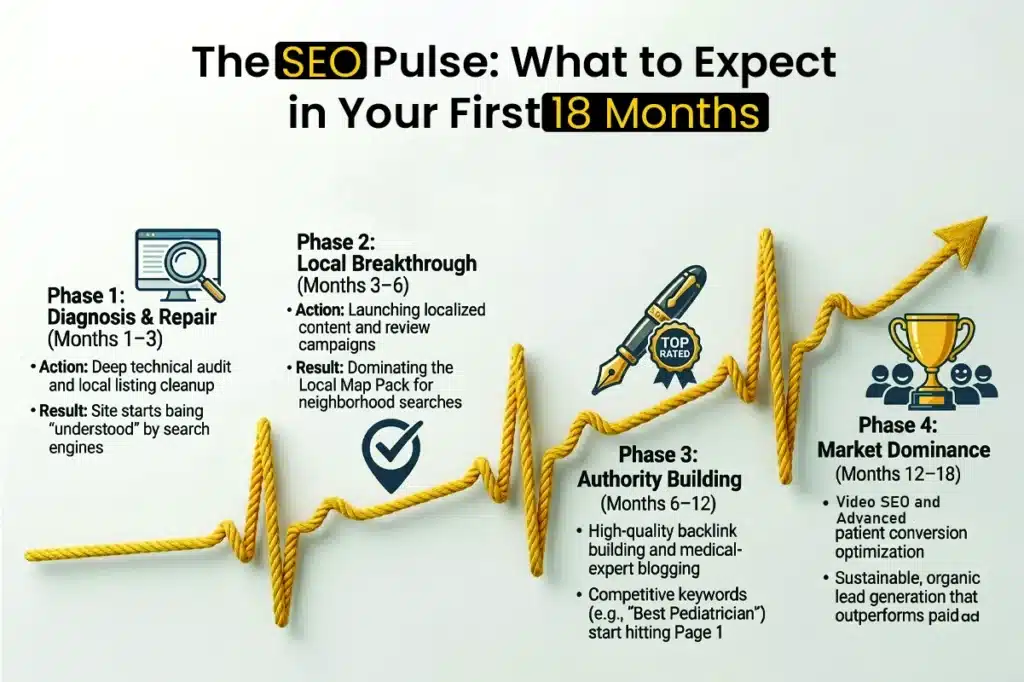
Healthcare SEO is a long-term strategy. Most clinics start seeing noticeable improvements in rankings and traffic within 3 to 6 months, while strong, consistent results often take 6 to 12 months.
The timeline depends on factors like competition in Dubai, website quality, content depth, and how well your strategy follows E-E-A-T and DHA compliance. High-quality, clinically reviewed content tends to perform better over time and is less affected by Google updates.
The best keywords combine medical relevance with patient search intent. These usually fall into three categories:
A strong strategy focuses on both English and Arabic search terms and groups them into content clusters to build authority on specific medical topics.
Local SEO helps your clinic appear in “near me” searches and Google Maps results, where patients are often ready to book an appointment.
Optimizing your Google Business Profile, maintaining accurate contact details (NAP), and collecting patient reviews can significantly improve visibility. In Dubai, adding details like accepted insurance networks and multilingual support further enhances trust and conversions.
Content marketing is the foundation of healthcare SEO. It helps educate patients, answer their questions, and guide them through their healthcare journey.
High-performing content includes condition guides, treatment comparisons, FAQs, and doctor profiles. When this content is clinically accurate and regularly reviewed, it strengthens E-E-A-T, improves search visibility, and supports patient trust.
Patient reviews are a key ranking factor for local SEO and also influence patient decisions.
Encourage satisfied patients to leave reviews on Google, respond professionally to all feedback, and maintain a consistent review strategy. In Dubai, using platforms like WhatsApp for review requests can increase response rates. Always ensure responses remain professional and compliant with healthcare regulations.
AI can assist in drafting content, but it should never replace medical expertise. In healthcare SEO, accuracy and compliance are critical.
Any AI-generated content must be reviewed and validated by qualified medical professionals before publishing. This ensures it meets E-E-A-T standards, avoids misinformation, and complies with DHA regulations. AI works best as a support tool, not as the final authority in medical content creation.


