Hamza
March 4, 2026
0 Comment

Imagine asking your phone for the best coffee shop nearby and instantly getting a precise recommendation, without typing a single word. This is no longer futuristic; it’s the reality of local voice search, and by 2026, it’s poised to dominate how customers discover businesses.
Voice assistants like Google Assistant, Siri, and Alexa have changed the game. People now rely on them for quick answers, local recommendations, and even on-the-go purchases. For businesses, this shift presents a huge opportunity: those who optimize for voice search can reach customers at the exact moment they need a service, often before competitors even appear.
Optimizing your business for voice search isn’t just about adding keywords. It’s about understanding conversational queries, local intent, and AI-driven results. If you want to stay ahead, working with a local SEO agency can ensure your business appears where it matters most, in voice search results that drive traffic, leads, and sales.
By the end of this guide, you’ll understand the strategies, tools, and techniques needed to dominate local voice search in 2026, no matter your industry or location.
Voice search SEO is the process of optimizing your online content so that voice assistants can easily find, interpret, and deliver it as a spoken answer to a user’s query. Unlike traditional search, which relies heavily on typed keywords, voice search focuses on conversational language and natural phrasing.
For example, a typed search might be:
“Best Italian restaurant near me Dubai.”
Whereas a voice search might be:
“Hey Google, what’s the best Italian restaurant close to me?”
Optimizing for voice search requires understanding these conversational differences and designing content that mirrors how people speak.
Voice assistants rely on Natural Language Processing (NLP) and Artificial Intelligence (AI) to interpret the meaning behind a user’s query. They don’t just look at individual keywords; they analyze context, location, and user intent to provide the most relevant answers.
For local businesses, this means that ranking in voice search results goes beyond simply including the right keywords. It’s about ensuring your business is relevant, credible, and well-structured so that voice assistants can confidently deliver your information to users.
Some of the most important signals that influence voice search visibility include:
Voice search is dramatically changing the way people find information, particularly when it comes to local businesses and services. Unlike traditional typed searches, voice searches are often spontaneous, conversational, and intent-driven, meaning users are looking for quick, actionable answers. For businesses, this shift represents both a challenge and an opportunity: those who adapt can capture highly motivated customers at the exact moment of need.
By 2026, voice search will have become a primary tool for decision-making, especially on mobile devices and smart speakers. Users rely on it to:
These patterns highlight a fundamental difference from traditional search: voice search prioritizes immediacy, clarity, and convenience.
One of the most notable trends in voice search is its hyperlocal focus. Users frequently include terms like “near me,” “closest,” or “nearby” when asking questions. Voice assistants use this data to provide highly localized results, making it essential for businesses to optimize their local presence.
For example, a user might say: “Where is the nearest bookstore open now?” Businesses that maintain accurate location data, update hours of operation, and provide rich, location-specific content are far more likely to appear in these results. Hyperlocal SEO strategies, including location-specific landing pages, Google Business Profile optimization, and localized content, are key to capturing these queries.
The way results are presented in voice search differs significantly from traditional search engines. While traditional search often displays multiple links, featured snippets, and long lists of options, voice search typically delivers a single spoken answer or a very concise set of results.
This distinction means that strategies for ranking in voice search must focus on:
In short, success in voice search is less about keyword density and more about relevance, clarity, and accessibility of your information. Businesses that understand this shift and adjust their SEO strategies accordingly will gain a competitive edge in capturing local, intent-driven traffic.
Voice search algorithms place a strong emphasis on user intent and contextual relevance, often more than traditional search algorithms that rely heavily on exact keyword matching. Instead of simply scanning for keywords, voice assistants are designed to understand the meaning behind a query and deliver the most direct, helpful answer in real time. This makes voice search more semantic, conversational, and intent-driven compared to standard text-based search.
Key differences include:
For voice search, long-tail, question-based, and conversational keywords consistently outperform short, generic phrases. When users speak to voice assistants, they tend to ask complete questions rather than enter two or three-word search terms.
For example:
Generic keyword: “SEO Dubai”
Voice-friendly keyword: “What is the best local SEO company near me in Dubai?”
The second example reflects how real users speak. It contains intent, location, and a clear objective. Voice assistants are designed to interpret these natural phrases and provide precise answers.
To optimize effectively:
When your content mirrors the way people speak, it becomes easier for voice algorithms to match it with relevant spoken queries.
Google Business Profile plays a central role in local voice search visibility. When someone asks a voice assistant for nearby services, Google often pulls data directly from verified business listings.
Make sure the following details are accurate and consistent:
Consistency across directories is equally important. If your business information differs from one platform to another, search engines may question its reliability. Updated business hours, correct map pins, and active review management significantly improve your chances of appearing in local voice results.
Structured data, commonly implemented using JSON-LD format, helps search engines better understand the context of your content. While users do not see schema markup, search engines rely on it to interpret business details accurately.
Adding schema for the following elements strengthens voice search performance:
Schema markup improves your eligibility for rich results and featured snippets, which are frequently used as voice assistant answers. It provides clarity about who you are, what you offer, and where you operate.
Most voice searches happen on mobile devices. If your website loads slowly or performs poorly on smartphones, your visibility in voice search can suffer.
Key areas to optimize include:
A smooth user experience increases engagement and reduces bounce rates, both of which indirectly support stronger search performance.
Voice searches are highly localized. Users frequently look for businesses close to them, often including phrases such as “near me” or referencing specific neighborhoods.
To capture this intent:
For example, instead of writing generic content about digital marketing, create content tailored to a specific city or district. This signals relevance to search engines and increases the likelihood of appearing in local voice results.
By combining conversational keyword targeting, optimized business listings, structured data, mobile performance, and localized content, businesses can build a strong foundation for sustainable voice search visibility in 2026 and beyond.
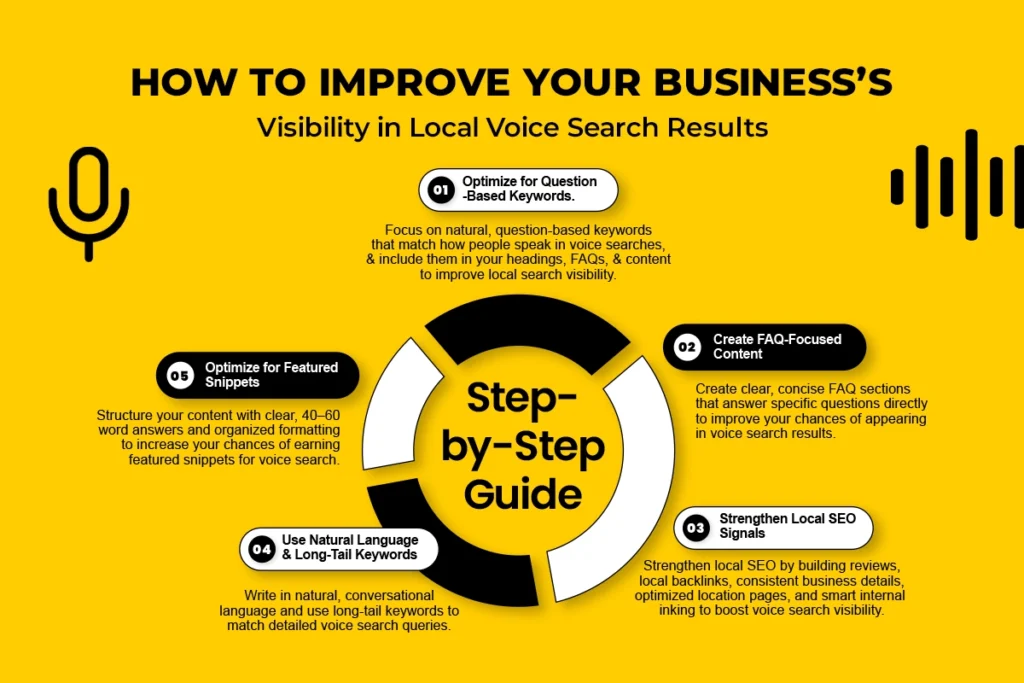
Voice search users typically ask complete questions rather than typing short phrases. This means your keyword strategy should focus on real, conversational queries that reflect how people naturally speak. Start by identifying common questions your target audience is likely to ask at different stages of their search journey. These questions often include intent, urgency, and location.
For example:
You can discover these questions through customer inquiries, search console data, community forums, and keyword research tools that highlight question-based searches. Incorporating these queries into headings, FAQs, and blog content increases your chances of matching voice assistant responses.
FAQ-focused content is highly effective for voice search because voice assistants prefer clear, direct answers to specific questions. A well-structured FAQ page allows search engines to easily extract concise responses that can be read aloud to users.
Instead of writing vague or overly complex explanations, provide straightforward answers that address user concerns clearly. Each FAQ should target a single question and deliver a precise, informative response. Adding FAQ sections to service pages, blog posts, and location pages further strengthens your visibility in voice search results.
Voice queries are conversational, detailed, and intent-driven. This makes natural language and long-tail keywords essential for effective optimization. Rather than forcing keywords into content, focus on writing in a way that mirrors real human conversation.
Use full sentences, simple wording, and context-rich phrases that align with spoken queries. For instance, instead of repeating a short keyword multiple times, include variations that sound natural within the content. This improves readability while also helping voice assistants better understand the context and relevance of your page.
Featured snippets play a critical role in voice search because assistants frequently pull answers directly from these highlighted results. To increase your chances of being selected, structure your content so that it answers key questions in a concise and informative manner.
Aim to provide clear answers within 40 to 60 words, supported by well-organized headings, bullet points, and short paragraphs. Use definition-style responses, step-by-step explanations, and question-and-answer formats to make your content easily scannable for search engines and voice algorithms.
Strong local SEO signals significantly improve your chances of appearing in voice search results, especially for location-based queries. Voice assistants prioritize businesses that demonstrate credibility, accuracy, and local relevance.
Focus on the following actions:
Additionally, you can naturally reference your service pages, such as Local SEO services Dubai, and link to other relevant SEO blog posts within your content. This internal linking strategy strengthens topical authority, improves site navigation, and helps search engines better understand the relationship between your pages, ultimately enhancing your overall voice search visibility.
Analyze queries, impressions, and click-through rates to see how your content performs in search and voice search.
Track which voice queries your site appears for, helping you identify gaps in optimization.
Monitor local rankings, citations, and competitor performance.
Track user engagement, searches, and clicks to understand how your profile performs in local voice searches.
Leverage AI tools to identify conversational queries and emerging voice search trends.
Use AI to predict conversational queries and tailor content that matches natural speech patterns.
Focus on entities (business name, products, services) and context rather than keywords alone.
Answer questions concisely to appear in Position Zero results.
Brands are integrating voice purchasing options through assistants, making it a strategic advantage.
Ensure key information (contact, address, FAQs) is directly available to users without requiring a click.
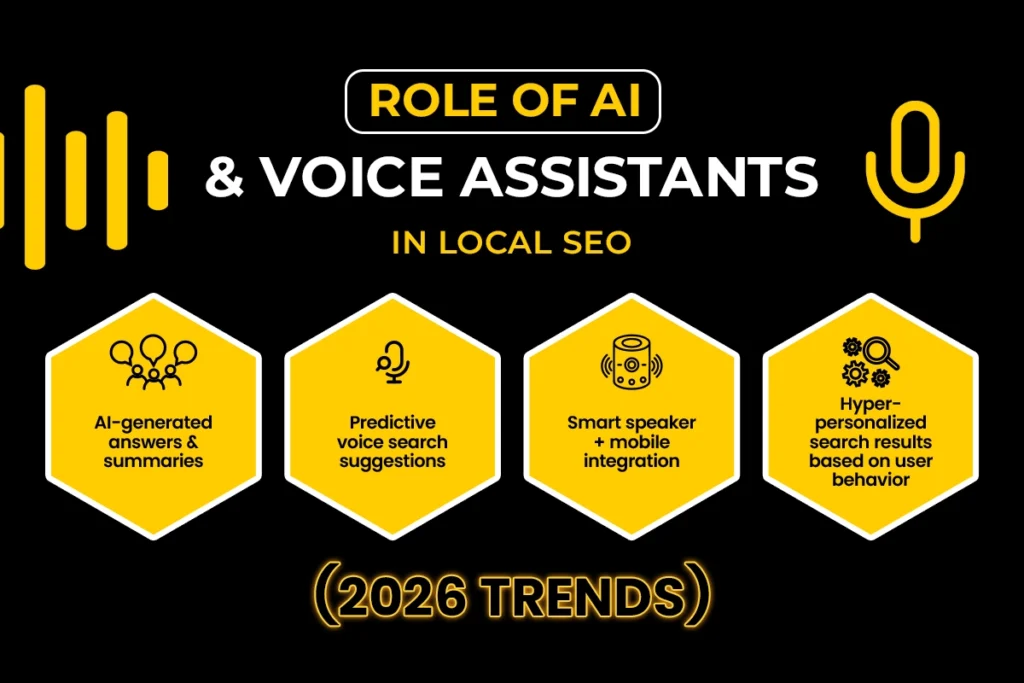
AI is revolutionizing voice search. Key trends include:
Businesses must anticipate these trends to remain competitive in local discovery.
When choosing a partner for voice search optimization, it is important to look for proven experience in voice search SEO along with strong local SEO knowledge. The agency should also have solid technical expertise in schema, structured data, and mobile optimization, as these elements directly influence how voice assistants interpret and rank your content.
In addition, their ability to create voice-friendly content, conversational landing pages, and well-structured FAQs is essential for capturing natural queries and featured snippet opportunities. Partnering with a professional local seo services agency and a reliable Local SEO agency that also provides comprehensive Local SEO services in Dubai can help ensure your business is fully optimized for local intent, voice queries, and sustainable long-term search visibility.
Stop losing local leads to competitors when customers search via Siri, Alexa, or Google. Partner with Alrwyt experts today to future-proof your business and dominate Dubai in 2026.
Many businesses struggle to appear in voice search results because they overlook the unique requirements of this search format. Voice search is highly conversational, mobile-driven, and context-sensitive. Ignoring these nuances can limit your visibility and prevent potential customers from finding your business at the right moment.
Some of the most common pitfalls include:
By addressing these common mistakes, businesses can strengthen their presence in local voice search, improve customer discovery, and capture highly intent-driven traffic.
Voice search is no longer a futuristic trend; it is now the standard for local discovery. Businesses that adapt to conversational search patterns, structured data, and strong local SEO signals will gain a significant competitive advantage in modern search ecosystems.
By implementing the strategies outlined in this guide, optimizing content for voice queries, and following a proven local SEO strategy, businesses can improve their visibility in both traditional and voice-driven search results.
Leveraging the right tools and continuously tracking performance also helps secure top positions in voice search outcomes. Preparing for AI-driven voice assistants ensures your brand remains visible, authoritative, and easily discoverable in the local market of 2026 and beyond.
Optimize your Google Business Profile, use conversational keywords, create FAQ-rich content, implement structured data, and build strong local citations.
Key elements include structured data, mobile optimization, question-based content, local backlinks, and ensuring your business info is accurate across all directories.
Reputable digital marketing agencies and local SEO specialists provide voice search optimization services, including content strategy, schema markup, and Google Business Profile management.
Top brands focus on AI-optimized content, entity SEO, featured snippet targeting, voice commerce readiness, and zero-click information accessibility.


