Hamza
April 14, 2026
0 Comment
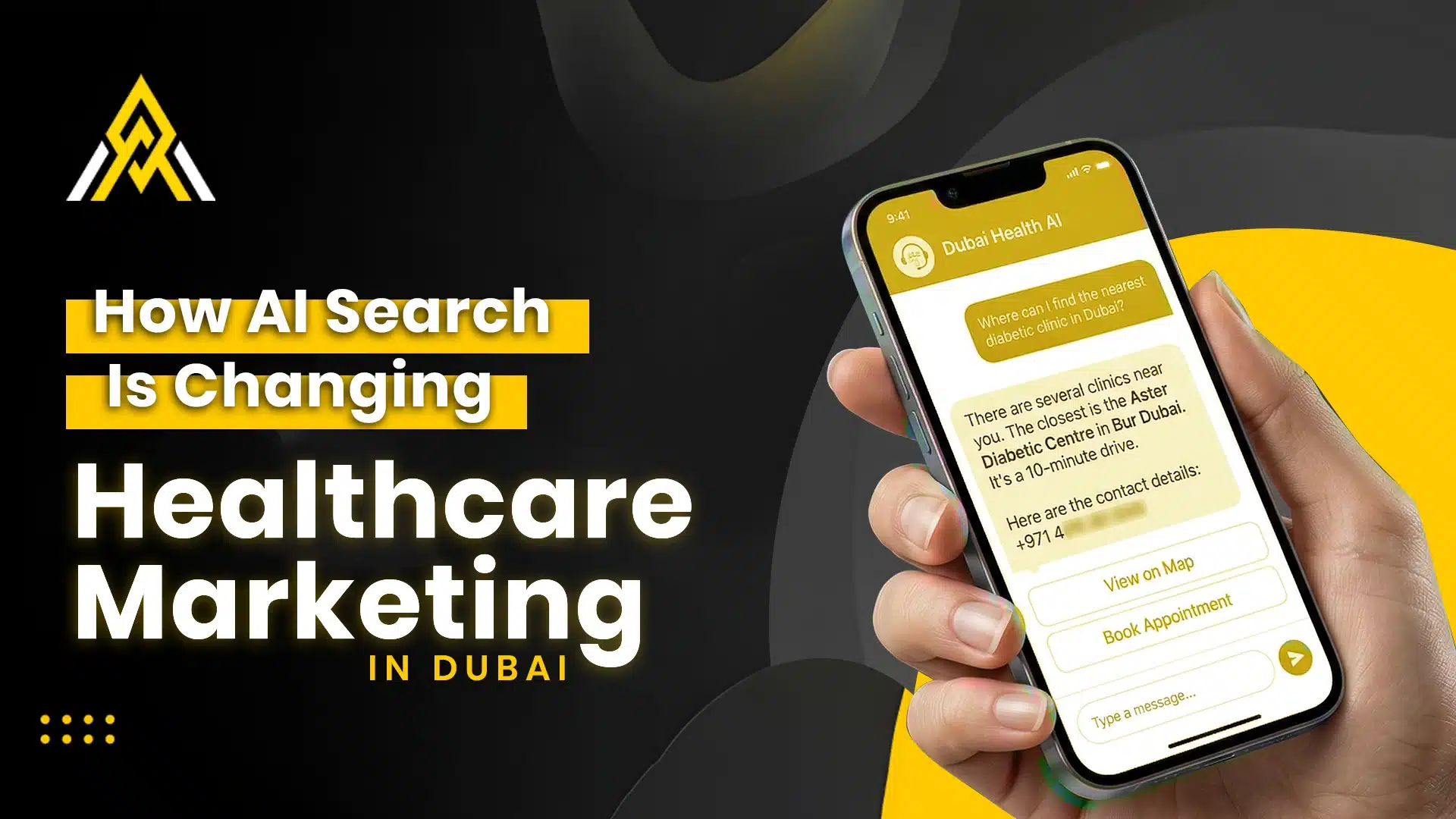
Search in Dubai has changed, and for healthcare providers, the shift is impossible to ignore. Patients are no longer scrolling through a page of links to find a clinic. They are asking full questions and receiving direct answers from AI-powered platforms like Google AI Overviews, ChatGPT, and Perplexity, etc. The answer they see first shapes the decision they make.
For clinics and medical centres in Dubai, this creates both an opportunity and a challenge. Those who understand how AI reads and selects content will appear in the answers that matter most. Those who rely solely on older SEO approaches will find their visibility shrinking, not because their content is incorrect, but because it is not structured for how search engines work now.
Key Takeaways
|
AI search uses machine learning to understand what a patient is actually asking, not just the words they typed. Instead of matching keywords to pages, it reads for meaning, evaluates the quality and clarity of content, and generates a direct answer from sources it considers accurate and trustworthy.
For healthcare searches in Dubai, this matters enormously. When someone asks, “Which dermatology clinic in Dubai is best for acne treatment?”, AI platforms do not return ten equal links. They surface one or two answers built from content they have determined to be clear, credible, and relevant to that specific query.
This is a fundamental shift from the traditional search model. A Healthcare SEO Agency in Dubai that understands how AI systems work builds content around this new reality, not just around ranking positions.
Patients have always wanted quick answers. AI search simply gives them that faster and more directly than ever before. A patient searching for a specialist, a procedure, or a clinic in a specific area in Dubai now often receives a summarised answer before they ever see a list of websites.
Because the decision friction is lower, when an AI platform surfaces a clinic’s name, location, reviews, and a clear description of its services in a single answer, the patient has most of what they need to make a decision. They are less likely to compare five different websites the way they once did.
This behaviour shifts where the competition actually happens. Visibility in AI-generated answers is now as important as, and in some cases more important than, a first-page Google ranking. Clinics that are not structured to appear in those answers are losing patients to those that are, even when both rank similarly in traditional search.
Find out where your clinic stands in Dubai’s new search landscape — and what to do about it.
Traditional SEO built visibility by placing the right keywords on the right pages and earning links from credible websites. Those fundamentals still matter, but they are no longer sufficient on their own.
AI systems are not scanning for keyword density. They are evaluating whether your content directly and clearly answers a patient’s question. A page optimised primarily for rankings, stuffed with phrases but light on genuine answers, will perform poorly in AI-generated results regardless of its position in organic search. That is where a full-scale healthcare seo agency comes to help you.
Content must now be written for two audiences simultaneously: the patient reading it and the AI system evaluating it. That means short, clear answers to specific questions, structured headings that signal what each section covers, and content that stays factually consistent across the entire website.
Working with a skilled seo agency dubai that understands both traditional ranking signals and AI content expectations gives clinics the coverage they need across both environments.
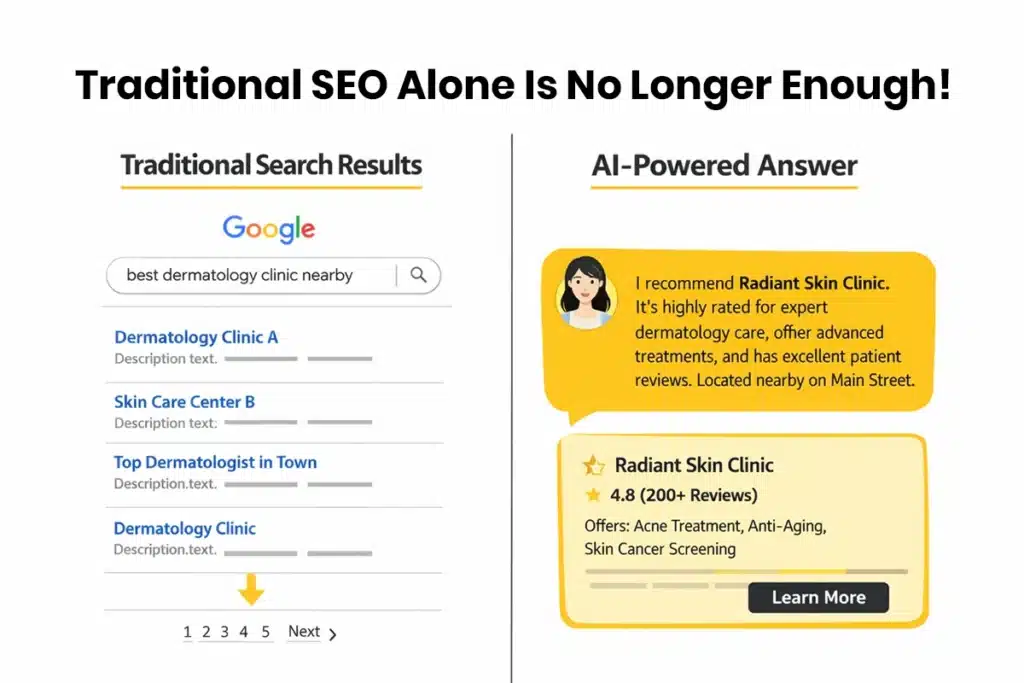
Answer Engine Optimisation, commonly referred to as AEO, is the practice of structuring content so that AI systems can extract it and present it as a direct answer to a user’s query. It sits alongside SEO as a distinct but complementary discipline.
Traditional SEO aims to rank a page. AEO aims to become the answer itself. When a patient asks an AI tool, “What are the symptoms of a vitamin D deficiency?”, the platform does not send them to a page; it generates an answer, often drawn from content that was clearly structured to address that exact question.
For healthcare providers in Dubai, AEO means writing in a way that mirrors how patients actually ask questions. FAQ-style sections, direct answers under clear headings, and concise explanations of treatments, procedures, and conditions all improve a clinic’s chance of being cited in AI-generated responses.
This is why Alrwyt Alwash integrates AEO principles into healthcare content strategies, not as a standalone tactic, but as part of a layered approach that strengthens both AI and conventional search performance.
The way content is organised on a page directly influences whether AI systems can extract and use it. A well-structured healthcare page, clear headings, direct answers near the top of each section, short paragraphs, and schema markup give AI platforms the signals they need to identify your content as a reliable answer source.
It looks like the content was written for the patient first. Short answers to specific questions. Headings that match the questions patients actually ask. Service pages that explain what a procedure involves, who it is for, and what a patient can expect, without requiring them to read five paragraphs to find the answer. That clarity benefits both the patient reading it and the AI system evaluating whether to cite it.
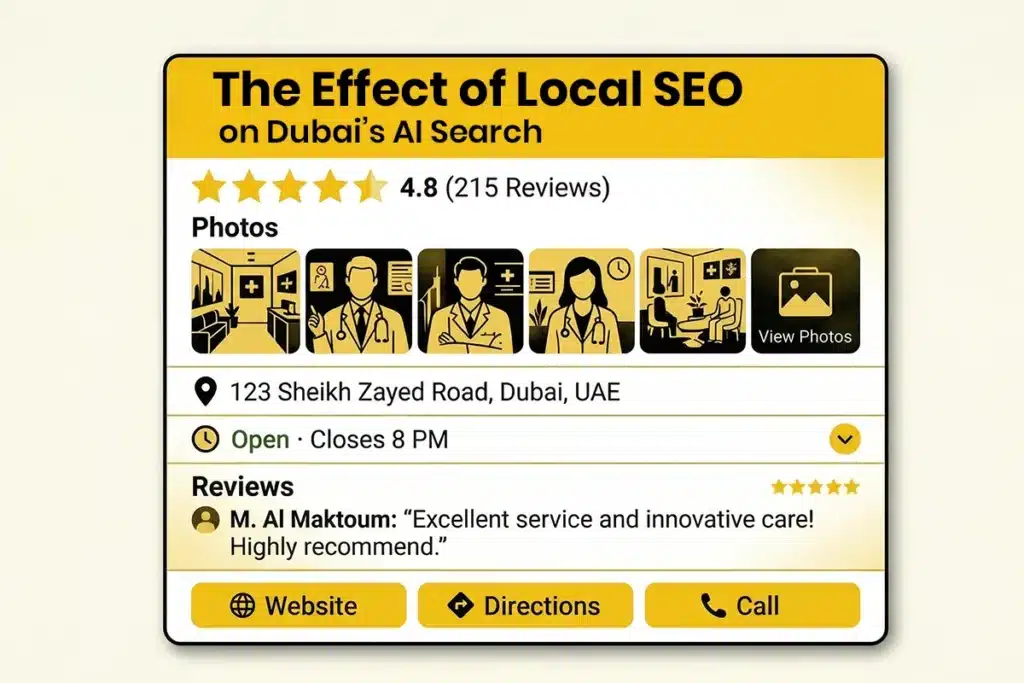
Local SEO has always been important for healthcare providers. AI search has made it more important still. When a patient asks “find a physiotherapy clinic near me in Dubai Marina”, the AI platform draws on location signals, Google Business Profile data, review quality, and business information consistency to determine what to surface.
AI systems cannot verify what they cannot find consistently. A clinic with incomplete or inconsistent information across platforms, different phone numbers, outdated addresses, missing service descriptions, signals unreliability. AI platforms favour businesses whose details are clear, complete, and consistent across every touchpoint.
This makes local SEO services in Dubai a direct contributor to AI search visibility, not just conventional map pack performance. Every local signal, reviews, business listings, location pages, and schema markup feeds into how AI systems understand and represent a healthcare provider to a patient making a query nearby.
We’ll audit your local presence and show you exactly what AI search is missing about your clinic.
Reviews have always influenced patient decisions. In an AI search environment, they carry additional weight; they are one of the primary trust signals that AI platforms use to evaluate whether a healthcare provider is worth citing.
Reviews that describe specific treatments, mention outcomes, and reflect genuine patient experiences give AI systems meaningful information to work with. A clinic with dozens of detailed, positive reviews across Google, Healthgrades, and other platforms is more likely to be cited in an AI answer than one with a handful of vague responses, even if both have similar star ratings.
Responding to reviews also matters. It demonstrates that a clinic is active, engaged, and credible, signalling that AI platforms use when assessing whether a business is trustworthy enough to recommend.
Dubai’s healthcare marketing operates under the guidelines of the Dubai Health Authority, which requires accurate, non-misleading content and clear representation of services. AI search actually reinforces this standard rather than conflicting with it.
AI platforms prefer accurate, verifiable, and factually consistent content. They actively deprioritise pages that make unsubstantiated claims or present information that conflicts with established medical guidelines. Clinics that already produce compliant, honest content, the kind DHA guidelines require, are inherently better positioned for AI visibility than those that have relied on inflated claims or keyword-heavy promotional language.
Compliance and AI search performance point in the same direction: clear, honest, patient-centred content.
Strategy, structure, and content — handled by a team that understands Dubai’s healthcare market.
AI search refers to platforms like Google AI Overviews, ChatGPT, and Perplexity that generate direct answers to patient queries rather than returning a list of links. In Dubai's healthcare market, this means patients often receive a clinician recommendation, service summary, or location-based answer without visiting multiple websites. Clinics must structure their content so AI systems can read, understand, and cite it accurately.
Patients increasingly ask full questions, "Which cardiologist in Dubai accepts walk-ins?", and receive instant answers from AI platforms before they see any traditional search results. This shortens the research process and means the first answer a patient sees carries significant weight in their decision. Clinics that are not visible in these answers lose consideration before the patient ever reaches their website.
Search for the questions your patients commonly ask, "best cardiologist in Dubai", "physiotherapy clinic near JBR", using Google, ChatGPT, and Perplexity, etc. If your clinic name does not appear in the AI-generated summaries or map results, your content and local data are not sufficiently structured for AI extraction. A structured content and local SEO audit will identify exactly where the gaps are.
AEO is the practice of structuring healthcare content so AI systems can extract and present it as a direct answer to a patient's question. It involves clear headings, short and specific answers near the top of each content section, FAQ formatting, and schema markup. Unlike traditional SEO, the goal is not just to rank a page but to become the source an AI platform chooses to cite when answering a relevant query.
Yes. Traditional SEO builds the domain authority and technical credibility that AI platforms use when deciding which sources to trust. Clinics with weak SEO foundations will struggle in AI search even if their content is well structured. The strongest healthcare marketing strategy combines traditional SEO, for authority, discovery, and organic traffic, with AEO content structure for AI-generated answer visibility.
AI search uses local signals, Google Business Profile data, review quality, NAP consistency across directories, and location-specific content to surface nearby clinics. A medical centre with complete, accurate, and consistent local information is far more likely to appear in location-based AI answers than one with incomplete or conflicting data. Strong local SEO is now directly tied to AI search visibility, not just Google Maps performance.
AEO improvements typically take longer to show than traditional SEO changes because AI systems update their citation preferences gradually as they re-index and re-evaluate content. Most clinics see meaningful visibility improvements within three to six months of implementing structural content changes, schema markup, and consistent local data updates. Regular content reviews accelerate this process.
Local SEO first. A complete and consistent Google Business Profile, accurate directory listings, and a strong review profile are the foundational signals that AI search uses to surface nearby clinics. Without these in place, AEO content improvements will have a limited impact because AI platforms cannot confidently identify or locate the business. Local SEO creates the base that AEO content then builds on.
AI search favours content that is accurate, clearly presented, and consistent, which aligns directly with DHA marketing guidelines. Clinics that already produce honest, non-misleading content are better positioned in AI search than those relying on inflated claims. In this sense, DHA compliance and AI search performance reinforce each other rather than conflicting.
The core principles are the same: clear structure, accurate content, and strong authority signals, but each platform has different preferences. Google AI Overviews draws heavily from pages Google already ranks well, so traditional SEO authority matters significantly. ChatGPT and Perplexity draw from a broader range of sources, including third-party mentions, reviews, and off-site citations. A clinic visible in both needs strong on-site content and an active presence across credible off-site platforms.


